SUPPLY CHAIN FRAGMENTATION AND ENERGY PREMIUMS IN THE INDO-PACIFIC AND GULF
Strategic Hook
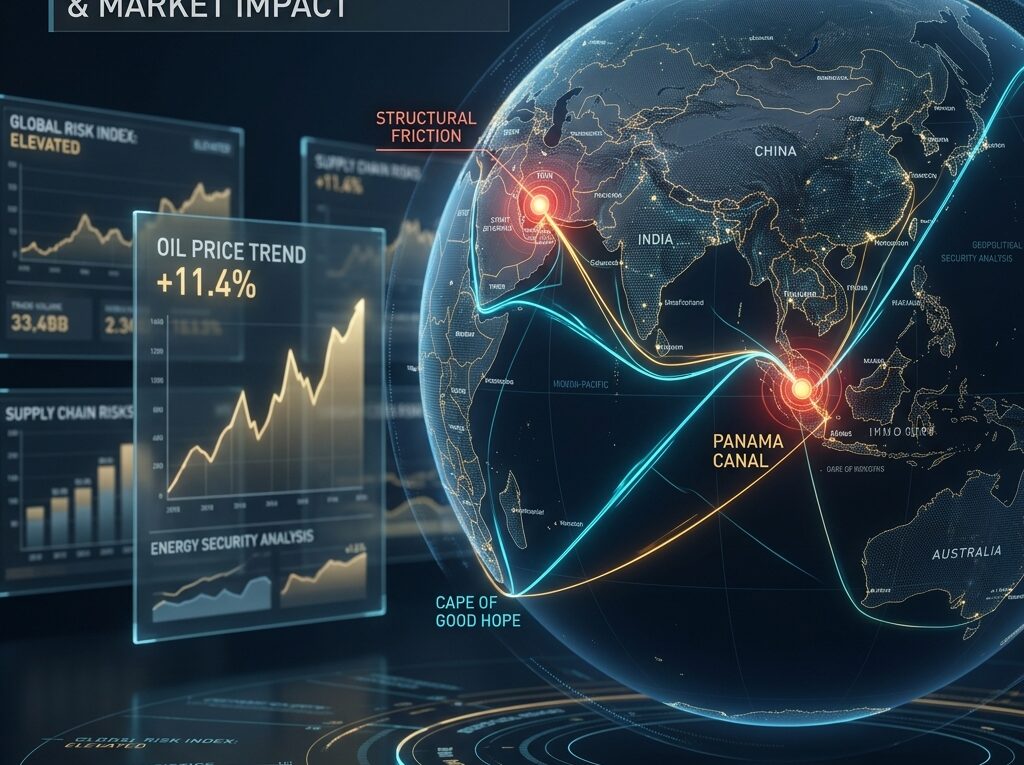
Global maritime trade and energy flows are currently processing a structural pricing shock, driven by concurrent physical disruptions in the Strait of Hormuz and administrative bottlenecks at the Panama Canal. For enterprise decision-makers and capital allocators, current data indicates a sustained “higher-for-longer” baseline for freight costs and energy risk premiums rather than a transient volatility event.
Data-Driven Market Realities
Energy and macro markets are directly pricing in the operational friction in the Middle East. Crude Oil has reached $113.44, representing a significant 11.11% structural elevation compared to its 30-day baseline of $102.1. Natural Gas follows this trend at $2.851, up 5.59% against its 30-day average, supported by LNG rerouting demands. Conversely, Gold is trading at $4,550.60, marking a 3.35% contraction from its monthly baseline, pressured by rising US 10-Year Treasury yields which have expanded to 4.446%. Financial projections indicate a 20-45 bps CDS widening for regional sovereigns and a 15-30% upward shock in SCFI/BDI freight indices, confirming an environment of tightening trade finance liquidity.
Operational Friction and Alliance Architecture
Maritime risks are distinctly isolated in two primary operational theaters. In the Strait of Hormuz, verified incidents involving vessel boardings, projectile deployments, and unauthorized toll demands have created an immediate supply shock variable. US warnings regarding sanctions on entities paying these tolls introduce severe compliance risks for operators. Concurrently, the Panama Canal is experiencing distinct administrative friction, underscored by Cosco’s operational suspension and the CK Hutchison arbitration. While causally separate from the Gulf, these Panama disruptions function as a compounding variable for global freight, restricting alternative routing for LNG and commercial tonnage.
In the Indo-Pacific operational area, defense architectures are hardening. Japan’s removal of its lethal weapons export ban, combined with new defense and energy pacts with Indonesia, the Philippines, and Australia, points to a structural shift in regional burden-sharing. Conversely, South Korea’s recent rebuff of US requests to join the Hormuz-focused “Project Freedom” highlights a calculated divergence between allied military integration and sovereign energy security mandates.
The Bottom Line
The confluence of elevated energy metrics and constrained maritime chokepoints sets a rigid stage for the upcoming May 14-15 Trump-Xi summit in Beijing. With Iran’s Foreign Minister also conducting post-escalation talks in China, these geopolitical friction points are poised to serve as direct leverage in bilateral negotiations over technology access and energy security. Operations executives and fund managers must internalize the 11% oil premium and the projected 30% freight index spike as the new operating baseline for Q2 2026.
INTERNAL STRATEGIC BRIEF: HORMUZ & INDO-PACIFIC
Context: This brief outlines the verified operational impacts of high-kinetic data points affecting global markets as of May 5, 2026. Stripped of intent inflation, it focuses strictly on observable metrics and structural outputs.
| Metric / Domain | Observation (Verified Data) | Strategic Output |
| Energy Pricing | Oil: $113.44 (+11.11% vs 30d). NatGas: $2.851 (+5.59% vs 30d). | Surges are structural, driven by hard supply/freight shocks, not standard cyclical volatility. |
| Macro Finance | DXY: 98.525. SP500: 7,200.75. US10Y: 4.446%. | 20-45 bps CDS widening for regional sovereigns; tightening trade finance liquidity. |
| Strait of Hormuz | Multiple vessel attacks, toll demands, US sanction warnings. | Forced routing adjustments driving a projected 15-30% spike in SCFI/BDI freight indices. |
| Panama Canal | Port disputes, Cosco operational suspension. | Constriction of alternate routes for LNG/freight; compound pressure on global supply chains. |
| Indo-Pacific Alliances | Japan lifts export bans; SK rebuffs US ‘Project Freedom’. | Increasing defense autonomy in Asia; clear limits to US operational burden-sharing requests. |
| Diplomacy | May 14-15 Trump-Xi summit; Iran FM visits China. | Geopolitical friction points functioning as backdrop/leverage for tech and trade negotiations. |