
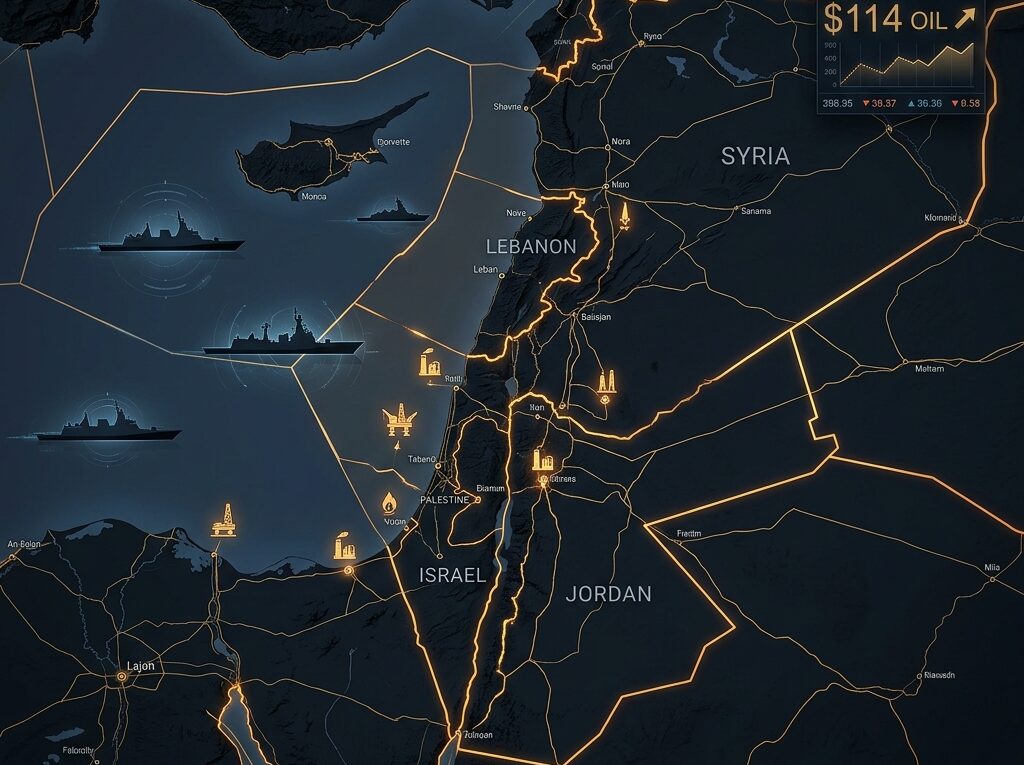
LEVANT STRATEGIC FRACTURE: ENERGY VOLATILITY AND THE REALIGNMENT OF REGIONAL SECURITY ARCHITECTURE
STRATEGIC HOOK
The Levant movement toward a nominal ceasefire has failed to de-escalate regional tensions, instead functioning as a high-kinetic pause for force reconstitution. Within the last week, the convergence of maritime interdictions in the Mediterranean, a surge in irregular warfare in Iraq, and the strategic positioning of naval assets near the Strait of Hormuz has pushed global oil prices to $114, representing a sharp escalation from the prior 30-day baseline. This shift signals that the theatre has moved from localized conflict to a broader structural fracture, where energy security and maritime transit are the primary levers of geopolitical pressure.
THE KINETIC REALITY OF THE LEBANON-ISRAEL CORRIDOR
The operational reality in the Israel-Lebanon corridor remains at a critical threshold. Despite diplomatic rhetoric, the immediate period has seen the execution of airstrikes against approximately 25 high-priority targets and the forced displacement of 12 additional villages in southern Lebanon. These actions, supported by German diplomatic declarations regarding the “operational necessity” of troop presence, suggest a long-term shift in the security buffer rather than a withdrawal.
Simultaneously, the counter-strike capabilities demonstrated by local actors—utilizing guided missiles and drone technology against armored units in Qantara—indicate that the technical proficiency of non-state forces remains intact despite sustained attrition. The cumulative fatality count, now exceeding 2,696, underscores the failure of current de-escalation mechanisms to secure the northern corridor.
THE IRAN-US STRATEGIC TRIANGLE AND ENERGY MARKET SHOCKS
The most significant structural shift involves the direct tension between the United States, Israel, and Iran. The pause in the 60-day War Powers clock by US Defense leadership provides a window of operational freedom that is currently being filled by the coordination of new strike packages. These packages target energy infrastructure and senior personnel, a development that has already been factored into the $114 oil price spike.
The assessment by US Intelligence that the Iranian nuclear timeline remains stagnant at the “one-year” threshold creates a persistent justification for kinetic re-engagement. The threat to the Strait of Hormuz and the interception of missiles by regional partners confirm that the maritime domain is now the primary theatre for Iranian retaliatory signaling. This is further compounded by over 600 documented attacks on US facilities in Iraq, indicating the opening of a persistent “secondary front” designed to overstretch logistics and political resolve.
MARITIME FRICTION AND THE COLLAPSE OF DIPLOMATIC OFF-RAMPS
The Gaza theatre has expanded into an international maritime crisis. The interception of a civilian-led flotilla in international waters near Crete and the subsequent detention of activists, including European nationals, has triggered criminal investigations in Italy. This adds a layer of legal and diplomatic friction that complicates the “Axis of Abraham” realignment, as Gulf states and Israel increasingly diverge on post-conflict governance models.
In the West Bank, the potential collapse of the Palestinian Authority (PA) is being treated by regional strategists as a manageable variable rather than a catastrophic risk. This shift toward a “slow war” strategy indicates a preference for containment over resolution, which likely guarantees sustained low-level kinetic activity for the foreseeable future.
REGIONAL POWER PROJECTION AND MODERNIZATION
Turkey’s role has shifted toward independent power projection. The SAHA 2026 showcase of new naval vessels and one-way attack drones, combined with the training of rival Libyan forces under the “One Army” initiative, signals Ankara’s intent to act as a regional balancer. The acquisition of 50 advanced fighter aircraft (F-35s and F-15IAs) by regional actors, supported by an $8.6 billion US arms fast-track, confirms that the institutional expectation among major powers is one of sustained, high-intensity multi-front operations.
THE BOTTOM LINE
The Levant has entered a phase of Escalation Determinism. The current “ceasefire” is not a transition to peace but a reconfiguration of the battlefield. Decision-makers must prepare for a sustained environment of $110+ oil prices, increased maritime insurance premiums in the Mediterranean and Hormuz, and a fragmented security architecture where state and non-state actors operate with high technical autonomy. The next 72 hours are critical for observing whether the “War Powers” legal pause in Washington translates into a direct strike on Iranian infrastructure, which would solidify the shift toward a full-scale regional confrontation.
INTERNAL STRATEGIC BRIEF
| Sector | Strategic Indicator | Technical Status | Structural Impact |
| Energy | Crude Oil Price | $114.00 | 34% surge above 30-day baseline; pricing in Hormuz risk. |
| Maritime | Interdiction Density | High (Crete/Hormuz) | Internationalization of conflict; Italian probe adds legal friction. |
| Kinetic | Iraq/Syria Attacks | 600+ | Effective “Second Front”; attrition of US logistical depth. |
| Defense | Procurement | $8.6B (US Fast-Track) | Preparation for high-intensity, multi-front long war. |
| Diplomatic | Alliance Status | Fragmenting | Divergence between Gulf states and Israel on post-war governance. |
#LevantStrategy #EnergySecurity #OilPriceShock #Geopolitics2026 #MaritimeSecurity #DefenseModernization #StrategicIntelligence