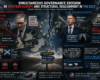

GLOBAL ENERGY SECURITY UNDER HORMUZ BLOCKADE AND SYSTEMIC RECESSION RISKS
Executive Summary: The effective closure of the Strait of Hormuz is disrupting global supply chains, while record-breaking U.S. oil exports provide a temporary ballast for markets. The IMF’s worst-case scenario warns that oil hitting $125 could trigger the fifth global recession since 1980.
📊 STRATEGIC POWER SHIFT AND FORESIGHT (V54.6)
- THE HIDDEN PLAY: Washington’s threat to formalize the Hormuz blockade is less about forcing Iran into JD Vance’s peace plan and more about cementing the U.S. position as the “Barrel of Last Resort” in global energy markets. China’s unexpected resilience indicates that Beijing has successfully weaponized its Middle Eastern energy dependencies into long-term geopolitical leverage.
- BLACK SWAN: A potential kinetic strike by Iran on Qatari energy infrastructure serves as the ultimate trigger, capable of instantly spiking European gas prices (currently stable at ~€41/MWh) back above the 2022 crisis peaks.
DOMINO EFFECT (CAUSALITY CHAIN):
graph TD
    A["Permanent Hormuz Blockade
20% Global Supply Disruption"] --> B["Fiscal Deficits & Debt Crisis
IMF Systemic Risk Warning"]
    B --> C["Inflation Shock in India/Japan
29-Year Bond Yield Peaks"]
    C --> D["Global Demand Destruction
IEA 2026 Contraction Forecast"]
    D --> E["Systemic Global Recession
Growth Below 2% Threshold"]
Strategic Analysis and Fracture Points (Macro & Systemic)
The S&P 500’s return to pre-war indices (as noted by Ian Bremmer) should be interpreted as the market internalizing a state of permanent blockade rather than a decrease in geopolitical tension. The record 12.7 million b/d of U.S. exports (confirmed by Javier Blas) remains the fragile foundation of this current market calm. Furthermore, the 29-year high in Japanese bond yields (as reported by Nikkei Asia) signals that inflationary pressures have moved beyond commodities and are now destabilizing sovereign financial instruments.
Risk Scenarios (HARDENED CAUSAL MATRIX TABLE)
| SCENARIO NAME | Probability | Duration | RED TEAM (FALLBACK/COUNTER) |
|---|---|---|---|
| Qatari Kinetic Disruption | 35-45% | 4-6 Weeks | Iran’s asymmetric move; triggers EU crisis (TTF > €100). Red Team: U.S. attempt to open the Strait by force. |
| Advanced Economy Bond Collapse | 25-30% | 3-6 Months | Inflation in Japan/India exceeding 6%. Red Team: Forced interest rate spikes sacrificing growth. |
| U.S. Export Capacity Ceiling | 55-65% | 8-12 Weeks | Tanker traffic hitting logistic limits (103 tanker flow). Red Team: Canada/Germany fueling demand via tax cuts. |
Strategic Watchlist (QUANTITATIVE THRESHOLDS ONLY)
- Brent/WTI Prices: > $110 (IMF Recession Trigger)
- Japan 10Y Yield: > 1.2% (Systemic Bond Collapse)
- TTF Gas (MWh): > €65 (European Energy Doctrine Failure)
- India Inflation: > 5.5% (Emerging Markets Panic Signal)
pie title Global Oil Supply Outlook (Risk Allocation)
    "US Record Exports (Strategic Shield)" : 45
    "Hormuz Blockade (Priced-in Risk)" : 30
    "China Strategic Reserves" : 15
    "Unidentified/Lost Supply" : 10
graph TD
    X["Strategic Energy Crossroad"]
    X --> Y["US Supply Dominance
Exports > 12.7M b/d"]
    X --> Z["Asian Supply Shock
Japan/India Inflation"]
    Y --> W["Market Balancing"]
    Z --> W