
EUROPE’S HORMUZ GAMBIT AND THE HORN’S DOWNWARD SPIRAL
STRATEGIC PANORAMA — WEEKLY BRIEF
THEATRE: Red Sea & Horn of Africa | TIME HORIZON: Last 167 Hours
CORE SHIFT
Europe’s Hormuz coalition maneuver to fill the power vacuum created by the US-Iran confrontation is occurring simultaneously with the Sudan-Ethiopia fracture metastasizing into a proxy axis via the UAE vector. These are not parallel crises; they constitute a mutually reinforcing instability loop in which maritime security and land-based state capacity are degrading in synchronized fashion.
SECTION 1: STRATEGIC PANORAMA
The signal flow of the last 167 hours resolves into two concurrent structural fractures.
Axis 1: European Power Projection at Hormuz
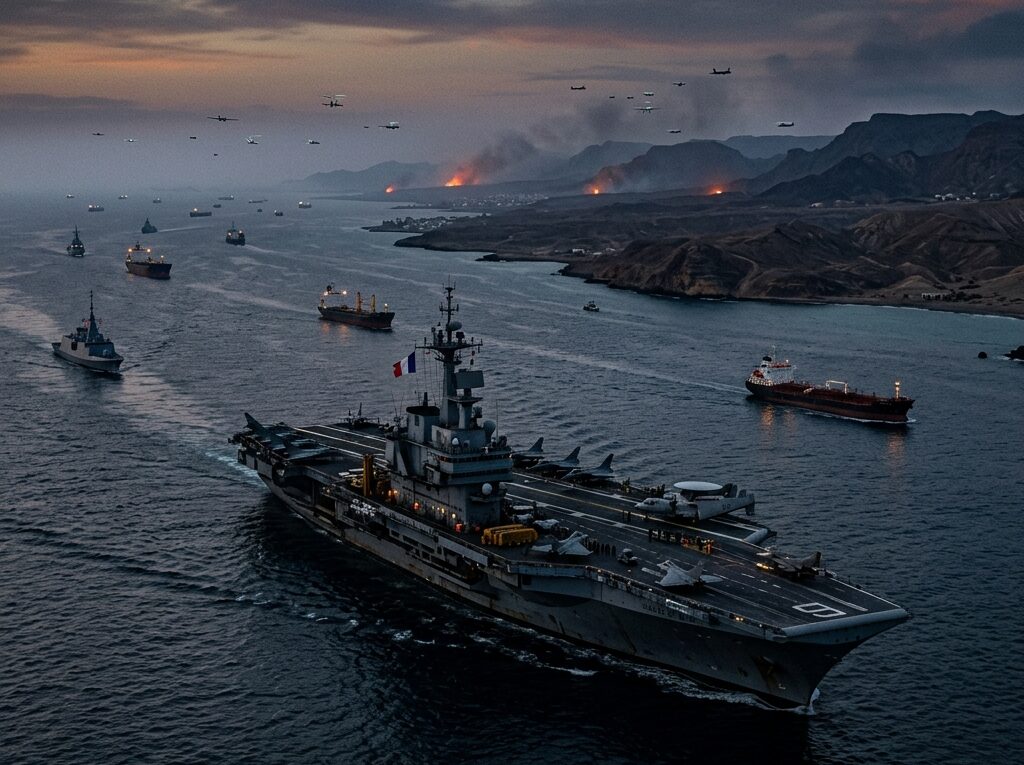
The Charles de Gaulle Carrier Strike Group has transited the Suez Canal and is now operating in the Red Sea as the kinetic anchor of a France-UK led multinational coalition targeting restoration of freedom of navigation through the Strait of Hormuz. Three parameters define the strategic weight of this deployment: (1) Iranian coordination is required — this is explicitly framed as a non-confrontational initiative, not a Tehran countermeasure; (2) it signals a European security architecture operating parallel to, but structurally distinct from, US posture; (3) emphasis on mine clearance operations reinforces the “defensive” framing, providing diplomatic insulation.
The pattern here is not military escalation. It is Europe positioning as the mediating security provider in a bilateral US-Iran deadlock, opening strategic market share in the process. Oil at $101.29 — against a 30-day baseline of $101.75 — indicates markets have already priced partial Hormuz degradation. Coalition success would exert downward price pressure; failure would produce the inverse.
Epistemic caution: source clustering is Tier 4 heavy. Iran’s actual acceptance of this framework — the variable upon which the entire initiative’s viability rests — remains unconfirmed.
Axis 2: Layered Fracture in the Horn
The Sudan-Ethiopia confrontation has crossed a diplomatic threshold: Khartoum recalled its ambassador from Addis Ababa. Sudan’s accusation that UAE-supplied drones were launched from Ethiopian territory, if substantiated, reframes this from a bilateral dispute into a proxy architecture operating across the Horn. The concurrent signal of Egyptian Rafale jets deployed to the UAE (unverified, Tier 4) indicates either a genuine threat posture by Abu Dhabi or a consolidation of regional hard-power alignment — both readings position the UAE as an active security-shaping actor across multiple sub-theatres simultaneously.
Yemen’s layered collapse continues: security governance failures in government-controlled areas (Wesam Qaid assassination, Aden) compound the structural military dysfunction of an army operating on $38-$116 monthly wages. Saudi consolidation efforts in the south are actively undermined by these governance gaps.
Peripheral Signal Synthesis
Somalia’s hunger crisis and the resumption of piracy — three vessels hijacked in the Gulf of Aden — are not discrete events. They are symptoms of system carrying-capacity failure. Combined with Houthi Red Sea pressure, these signals aggregate into a measurably elevated trade-route risk premium. Libya’s largest refinery resuming operations provides marginal stabilizing offset to regional energy supply, but insufficient to alter the directional vector.
SECTION 2: PATTERN & CAUSALITY ANALYSIS
Causal Link 1: Hormuz Constraint → Red Sea Demand → Horn Competition
The causal chain is cyclical, not linear. Hormuz restriction elevates the strategic value of Red Sea alternative corridors. Elevated corridor value triggers actor repositioning — UAE, Egypt, France, UK — to consolidate influence over those corridors. The resurgence of Somali piracy in this context reads not as independent criminality, but as opportunistic exploitation of a security attention deficit.
Causal Link 2: UAE Vector — Sudan, Egypt, Yemen
A consistent UAE pattern is legible across the data: drone-supply allegations in Sudan, Egyptian military deployment to UAE territory, and historical influence architecture in southern Yemen. The directionality — whether this represents deliberate regional expansion or defensive consolidation against Iranian overpressure — cannot be resolved from the current signal set without additional confirmation.
Causal Link 3: State Capacity Erosion Loops
The Boko Haram attack in Chad (23 soldiers killed), Yemen’s military wage collapse, and Somalia’s humanitarian compression are not thematically related events placed in the same brief. They perform the same structural function: eroding state capacity at the periphery of the conflict basin. Eroded state capacity generates security vacuums. Security vacuums increase the operational cost of conflict management for all actors in the system. This is a self-reinforcing loop.
Epistemic Flag: Sudan’s attribution of drone attacks to UAE-Ethiopian coordination rests on Tier 4 and Tier 2 sourcing. Causal weight assigned to the UAE proxy hypothesis should be held at “plausible but unconfirmed” until corroborating signals emerge.
SECTION 3: STRATEGIC VECTOR & ACTION
High Probability (60-75%): The European coalition achieves partial Hormuz navigational function without Iranian full acceptance — creating a constrained but operational corridor under diplomatic caveats. Oil prices remain range-bound, simultaneously pricing partial Hormuz opening and persistent Gulf of Aden risk premium.
Medium Probability (40-55%): Sudan-Ethiopia confrontation is contained below large-scale military exchange through diplomatic channels; however, if UAE attribution is confirmed, regional impact widens materially, reshaping southern Red Sea maritime security calculus in ways that directly interact with the Hormuz coalition’s operational assumptions.
Critical Trigger to Monitor: Iran’s formal response to the France-UK coalition framework. Acceptance creates a significant European security dividend and exerts downward energy price pressure. Rejection collapses the coalition’s political credibility and unlocks the next price band upward.
Board-Level Action Point: Supply chains dependent on Hormuz transit should activate alternative routing protocols independent of coalition negotiation outcomes. Humanitarian collapse in Yemen and Somalia will generate northward migration pressure that expands Europe’s strategic interest horizon well beyond maritime security — creating downstream political risk for the same governments currently funding the Hormuz coalition.