
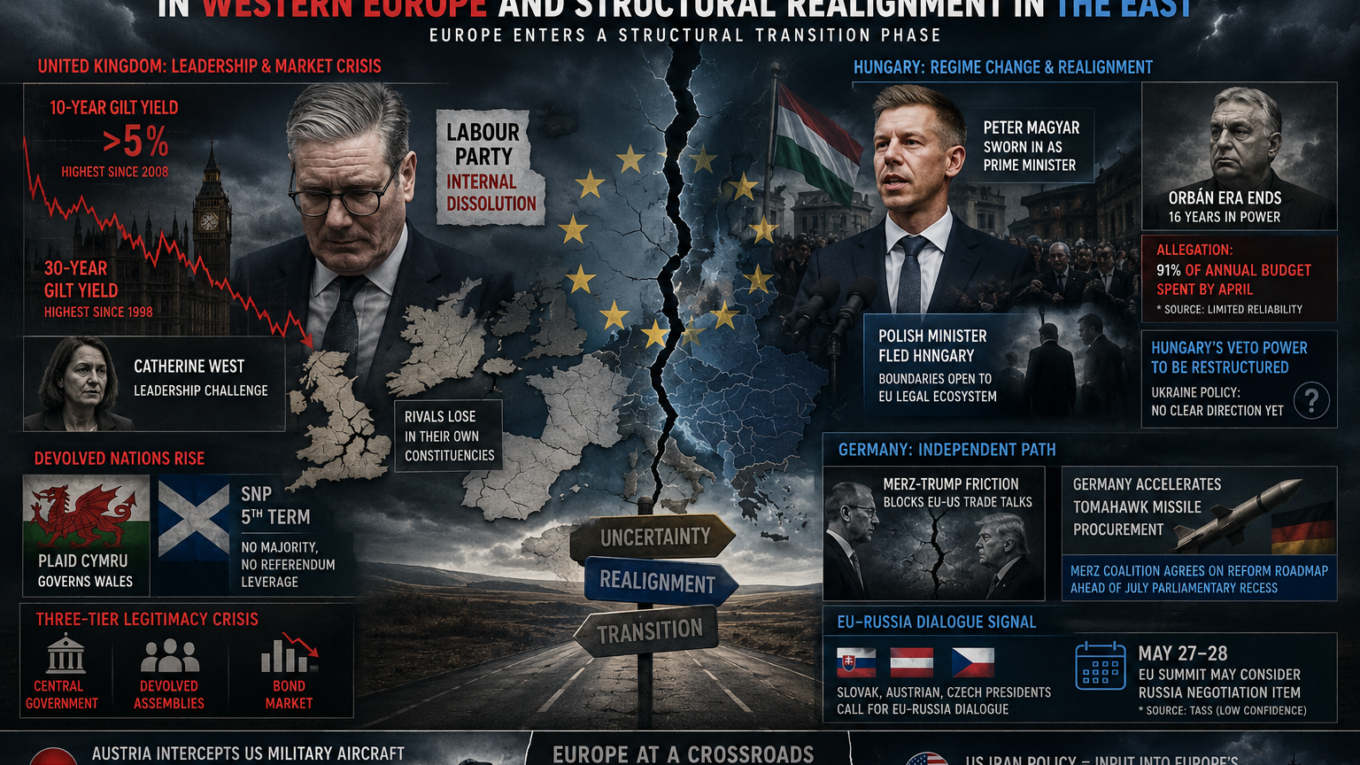
Simultaneous Governance Erosion in Western Europe and Structural Realignment in the East
THE CORE SHIFT
Single-week leadership fractures across two of Europe’s major constitutional axes — the United Kingdom and Hungary — indicate that the continent has entered a structural transition phase, not a reactive one. This simultaneity may represent not coincidence but the deepening of an institutional legitimacy deficit in Western Europe, concurrent with a rewriting of alignment parameters on the eastern flank.
STRATEGIC PANORAMA
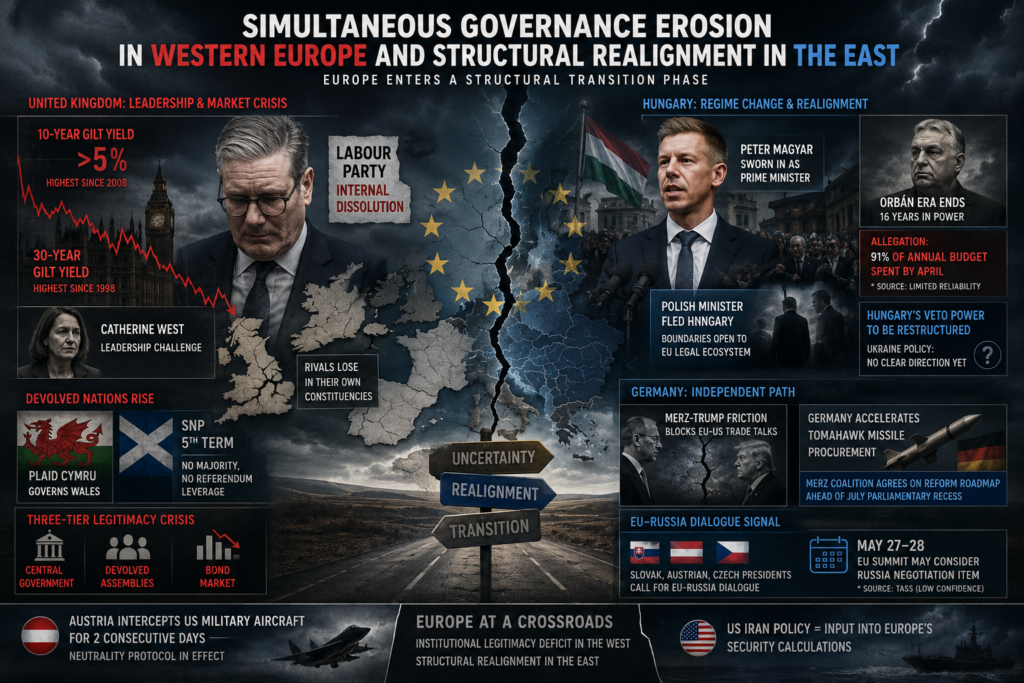
Bloomberg-confirmed data places UK 10-year gilt yields above 5%, the highest since 2008, with 30-year yields at levels not seen since 1998. These figures document a measurable fiscal stress condition, not an atmospheric one. Two data points converge: Starmer’s internal party dissolution and the bond market’s pricing response to that dissolution. The Financial Times confirmed MP Catherine West’s public leadership challenge, while Bloomberg documented multiple Labour rivals suffering electoral losses in their own regions. The fact that potential successors have lost ground in their own constituencies signals that no credible alternative corridor has yet formed against Starmer. This extends the uncertainty window; markets price extended uncertainty as more costly than an early leadership transition.
The UK’s fragmentation pressure does not remain at the Westminster level. The Financial Times and Bloomberg confirmed Plaid Cymru’s ascent to govern the Welsh Senedd and the SNP’s fifth consecutive term in the Scottish Parliament. The SNP fell short of a majority threshold, which means no binding referendum leverage exists in the near term. Nevertheless, constitutional authority centrifugal pressure is already operational. Simultaneous legitimacy challenges across three governance tiers — central government, devolved assemblies, and the bond market — constitute not a single event but a self-reinforcing cycle.
The structural rupture is sharper on the Hungarian front. Al Jazeera and TASS confirmed Peter Magyar’s swearing-in as prime minister and the end of Orban’s 16-year rule. One source — whose reliability is limited and must be named explicitly — alleges that the outgoing Orban government consumed 91% of its annual budget by April. If confirmed, the incoming Magyar administration inherits not a political legacy but a structural fiscal crisis. Bloomberg also reported that a Polish minister sought abroad fled Hungary following Orban’s fall, making concrete the permeable boundary the Orban era maintained with the EU legal ecosystem. Hungary’s veto dynamics over EU and NATO agendas will restructure; however, Magyar’s position on Ukraine policy does not yet offer a clear directional vector. The incoming foreign minister’s statement ruling out weapons or troops for Ukraine was carried by TASS and must be assessed with that source’s editorial orientation in view.
A different tension operates on the German axis. Bloomberg confirmed that the personal friction between Trump and Merz is blocking EU-US trade negotiations, while the Financial Times reported Germany’s accelerated procurement of Tomahawk cruise missiles. Read together, these moves indicate that Germany is pursuing independent deterrent capacity construction while experiencing diplomatic cooling with Washington. Bloomberg confirmed that the Merz coalition reached agreement on a reform roadmap ahead of the July parliamentary recess; this convergence signals not a reduction of intra-coalition pressure but a recognition of the cost of further deferral.
A distinct signal is present in the EU-Russia negotiation channel. Multiple TASS-sourced reports — to be read with limited weight as Moscow’s positional output — indicate that the Slovak, Austrian, and Czech presidents have advocated for EU-Russia dialogue, and that the EU will consider placing a Russia negotiation item on its agenda on May 27-28. This is a structurally significant signal arriving via a low-confidence source. If the May 27-28 agenda item receives confirmation from official EU mechanisms, the signal flow identified this week will be read retrospectively as a leading indicator of a larger fracture.
A peripheral but contextually material data point: Defense News — a secondary source requiring independent confirmation — reported that Austria intercepted US military aircraft on two consecutive days under its non-NATO neutrality protocol. Austria closing its airspace to US activity linked to Iran, in the same week Rubio demanded allied commitment on Iran pressure, places these events in the same political space. US Iran policy is functioning as a direct input into European allies’ security calculations.
STRATEGIC VECTOR & PROJECTION
For the United Kingdom, the primary monitoring threshold is the 30-year gilt yield approaching the 5.5% band, at which point the Treasury would face pressure to issue a fiscal reframing statement; if that threshold is breached, the leadership debate converges with economic necessity. For Hungary, Magyar government’s first official position statement on Russia-Ukraine policy during the July parliamentary session will serve as the test of whether the veto bloc constructed under Orban has been dismantled. On the EU-Russia axis, whether the May 27-28 EU summit agenda documents formally list a Russia negotiation item will determine whether this week’s signal flow is structural or noise.
STRATEGIC TAGS
#WesternEuropeGovernanceErosion #GiltMarketPoliticalRisk #HungaryAlignmentShift #EURussiaNegotiationWindow #GermanyStrategicAutonomy #UKConstitutionalCentrifuge #RubioAllyPressure