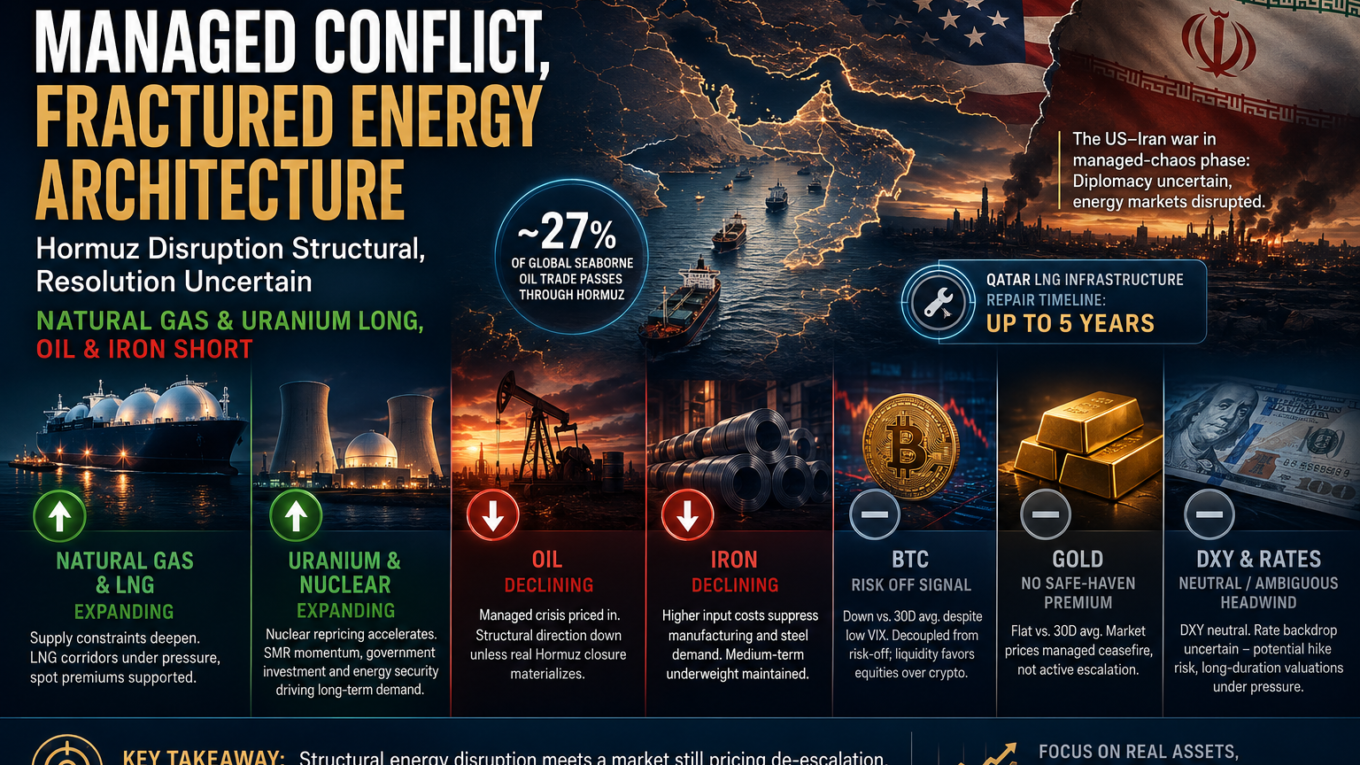
Hormuz Energy Crisis Intersects Technology Deflation: Nuclear SMR and AI Infrastructure Approaching Critical Cost Curve Thresholds — Expand Optionality Portfolio with Solar and Grid
CORE TECHNOLOGY THESIS
The Hormuz crisis’s permanent questioning of fossil fuel reliability created a structural acceleration layer for energy technology cost deflation: solar modules advance toward 0.06 dollars per watt by 2030 at a 24 percent learning rate, while nuclear SMRs at a 10 percent learning rate generate first real commercial construction data. The Strategic Delta moves beyond yesterday’s general SMR long thesis: NUCLEAR_SMR closed 6.12 percent above its 30-day average today, and ARK Invest Research accumulated 300,017 Nvidia shares across five ETFs — a commercial-intent signal for AI compute deflation positioning. These two signals are not separate; they reinforce each other because AI infrastructure demands growing electricity, and that demand feeds back into nuclear and grid infrastructure pricing.
COST CURVE STATUS
Solar PV (SOLAR_PV)
Unit: dollars per watt (utility-scale module, ex-China). Current estimated cost 2025: 0.10 dollars per watt; 2020 baseline was 0.21 dollars per watt; learning rate 24 percent. Base-case 2030 projection: 0.06 dollars per watt. Critical threshold: 0.05 dollars per watt, at which point global rooftop parity closes. Important note: these figures cover module cost only. Balance-of-system plus installation adds 0.30 to 0.50 dollars per watt. Current LCOE has reached competitive levels in most markets. Oilprice.com analysis confirms the Hormuz crisis is directing investor attention toward restructuring of American electricity infrastructure, reinforcing long-horizon pricing for solar and grid assets.
AI Compute (AI_COMPUTE)
Strategic Memory node R-1: learning rate 29 percent, 2027 projection 0.03 dollars per TFLOP-h, autonomous agent threshold of 0.01 dollars per TFLOP-h not yet reached. Today’s Strategic Delta: ARK Invest Research acquired 300,017 Nvidia shares on Monday across five ETFs. ARK signals carry an implied five-year price target framework; this purchase reads as institutional optionality positioning toward the compute deflation curve between 2027 and 2030. AMD confirmed agentic AI is expanding the server CPU opportunity faster than expected. Jensen Huang’s one-trillion-dollar valuation call on Marvell Technology (Computex) shows the bandwidth and networking layer of the AI semiconductor chain forming a cost curve independent of the compute core.
Battery — CELL Level (BATTERY)
Unit: dollars per kWh (LFP CELL level — NOT pack level). 2025 estimate: 72 dollars per kWh cell level; learning rate 19 percent; 2030 projection: 42 dollars per kWh. Critical note: PACK cost (including BMS, thermal management, housing) adds 15 to 25 percent above cell; Chinese manufacturer pack runs 84 to 90 dollars per kWh, Western OEM pack runs 110 to 130 dollars per kWh. Bias guard active from payload: the 2030 projection of 42 dollars per kWh (cell) assumes uninterrupted learning curve; material bottlenecks and quality premiums could slow the curve, and this figure should be flagged as optimistic when cited without qualification.
EV Drivetrain — PACK Level (EV_DRIVETRAIN)
Unit: dollars per kWh (full pack, automotive grade). 2025 estimate: 98 dollars per kWh; learning rate 15 percent; 2030 projection: 68 dollars per kWh. Critical threshold: 75 dollars per kWh — ICE total cost parity in compact segment. Bias guard active: the 68-dollar target requires sustained 15 percent learning rate and no tariff escalation on Chinese LFP into US and EU markets. Electrek’s Tesla Semi signal cluster confirms EV load capacity in heavy trucking, a structural signal showing EV penetration expanding from light vehicles into commercial transport. Tokyo’s 8,100-dollar EV subsidy (Nikkei) provides demand-side acceleration in Japan. The FT’s report on lithium exploration licenses acquired in Germany and Poland is a critical raw material signal for Europe’s China-independence effort, though production start remains years away.
Nuclear SMR (NUCLEAR_SMR)
Unit: dollars per kW (installed capacity, first-of-kind). 2024 cost: 8,500 dollars per kW; 2025 estimate: 7,000 dollars per kW; learning rate: 10 percent; 2035 projection: 4,500 dollars per kW. Critical threshold: 4,000 dollars per kW — LCOE competition with gas peakers. TerraPower Natrium targets 5,500 to 6,000 dollars per kW nth-of-kind. Today’s Strategic Delta: NUCLEAR_SMR 6.12 percent above 30-day average at 13.95 dollars. This deviation has two structural sources: first, repricing of nuclear for AI data center baseload power continuity demand; second, the Kazakhstan-Russia 16.4 billion dollar nuclear plant plan (The Diplomat) shows the global construction pipeline expanding, potentially accelerating the learning rate curve. NuScale’s new board members suggest active investor expectation management. The UAE nuclear plant drone attack and subsequent IAEA technical support may be adding a risk-premium component to investor attention.
Offshore Wind (OFFSHORE_WIND)
Unit: dollars per kW (installed, European North Sea). 2025 estimate: 2,700 dollars per kW; learning rate: 11 percent; 2030 projection: 2,000 dollars per kW. Critical threshold: 2,000 dollars per kW — merchant rate viability without subsidy in good wind regions. The 2022 to 2024 inflation wave reversed five years of decline; recovery continues. This week’s signal: Ørsted awarded UK offshore wind inspection contract to OEG (Splash247), confirming an active existing fleet maintenance pipeline. US costs run 20 to 30 percent above European levels — additional cost barrier to account for in US-focused positions.
Electrolyzer — Green Hydrogen (ELECTROLYZER)
Unit: dollars per kW (PEM electrolyzer, installed). 2025 estimate: 700 dollars per kW; learning rate: 16 percent; 2030 projection: 350 dollars per kW. Critical threshold: 350 dollars per kW, at which point green H2 approaches 2 dollars per kilogram. Current green H2 cost runs 4 to 6 dollars per kilogram; reaching the threshold requires both electrolyzer cost reduction and power below 20 dollars per MWh. This week’s payload carries no direct electrolyzer signal; solar and grid cost curves remain indirect structural supporters.
SECTOR DISRUPTION MAP
Gas Peaker Plants vs Solar Plus Battery Combination
The Hormuz crisis gas price shock exposed how vulnerable electricity markets remain to fossil fuel price swings — the phrase comes directly from oilprice.com’s analysis of what Hormuz is teaching traders about utilities. Solar modules at 0.10 dollars per watt (2025) combined with LFP battery cells at 72 dollars per kWh are collectively building economic competitiveness against gas peaker plants. However, grid integration and storage duration constraints imply a four-to-seven-year timeline before full substitution becomes material. The STRUCTURAL horizon is active, not the medium-term one.
AI Infrastructure Power Model
The EIA projects US natural gas power sector demand will surge in 2027 primarily from data center and industrial load growth. In the short term this confirms the NATG position from yesterday’s report. In the STRUCTURAL horizon, nuclear and solar baseload substitution will reshape how that demand is met, not whether the demand exists. AI compute’s 29 percent learning rate simultaneously increases physical power intensity per inference cluster and decreases cost per unit of compute — net effect is more data center buildout, which feeds back directly into nuclear SMR’s structural demand case because baseload continuity is a property solar cannot guarantee during dark or cloudy hours.
EV Expansion into Heavy Commercial Segment
Tesla Semi’s Covenant Logistics evaluation (Electrek) shows large-fleet commercial operators are now convinced of heavy-duty EV performance. Drivetrain pack cost at 98 dollars per kWh means heavy trucking displacement of diesel is two to three years behind the light vehicle segment. Tokyo’s subsidy and Europe’s lithium exploration signal support demand-side acceleration, though the bias guard remains active: Western OEM pack costs could remain 30 to 40 percent above Chinese manufacturers’, and tariff risk could stall the learning rate.
Grid Infrastructure as the Universal Enabling Layer
GRID_INFRA sits 1.55 percent above its 30-day average today at 969.67 dollars. GE Vernova crossed 4 million commercial operating hours on its H-class gas turbine fleet (Yahoo Finance/GRID_INFRA) and simultaneously acquired Robotech Automation to strengthen manufacturing and grid robotics. IEA warned global oil stocks are heading for historical lows ahead of summer peak, with severe heat waves straining power grids (oilprice.com). Grid infrastructure is therefore not a passive beneficiary but an active constraint on how fast solar, nuclear, and EV charging can scale. It is the enabling layer for all other technology themes in this dossier.
Nuclear SMR — Data Center to Baseload Transition
The most structurally clear convergence this week: Yahoo Finance’s “2 nuclear stocks every AI investor should follow” headline signals the AI-nuclear baseload narrative has moved into mainstream investment media. The structural reality is that a single hyperscale data center demands 1 GW or more of continuous power — a load profile solar cannot fill during off-peak hours. SMR fills that gap. Learning rate of 10 percent is the slowest among the cost curves in this dossier; reaching the 4,000-dollar-per-kW threshold requires a 2035 to 2040 window. What is pricing SMR today is not yet cost competitiveness but energy security and continuity premium — and that premium may persist regardless of final cost curve position.
OPTIONALITY CASCADE
Theme: Nuclear SMR. Hormuz questioning baseload reliability and AI data center expanding physical power demand together provide a stronger structural foundation for SMR optionality positioning today than at the start of this reporting cycle. Enter with small position size (kucuk agirlik), framing this as an opsiyonellik pozisyonu with asimetrik risk-getiri: cost curve is slow (10 percent learning rate) but pricing today runs on an energy security premium that short-circuits the cost argument. [SISTEM] NUCLEAR_SMR — cleanest carrier, direct SMR developer exposure, spot volatility elevated. Secondary: [SISTEM] NUCLEAR_UTIL — Duke Energy 97 percent capacity factor confirms existing fleet profitability and offers lower volatility for the same theme. Invalidation condition: second major SMR construction halt similar to NuScale VOYGR-6 cancellation, or NRC licensing process reversal under new leadership. Time horizon: STRUCTURAL.
Theme: AI Compute and Semiconductor Chain. ARK Invest Research’s 300,017 Nvidia share purchase Monday across five ETFs, read under ARK’s five-year price target framework, constitutes institutional optionality positioning on the compute deflation curve toward 2027 to 2030. Small position with asymmetric upside framing applies: as compute crosses 0.03 dollars per TFLOP-h by 2027, the agentic economics gate opens, which sustains GPU demand and independently drives bandwidth chip demand. [SISTEM] AI_CHIP — cleanest broad carrier. [MANUEL] NVDA — individual high-volatility position mirroring ARK weight. [MANUEL] MRVL — bandwidth and networking layer optionality following the Computex call. Invalidation condition: US expands chip export restrictions to China, or TSMC capacity constrained unexpectedly. Time horizon: LONG to STRUCTURAL.
Theme: Solar PV and Grid Infrastructure. Solar module at 0.10 dollars per watt advancing toward 0.06 dollars per watt by 2030 at a 24 percent learning rate is the fastest-moving cost deflation curve in this dossier. But module alone is not sufficient; balance-of-system and grid integration are required. Dual optionality position: [MANUEL] FSLR — First Solar, non-China module producer benefiting from tariff protection. [SISTEM] GRID_INFRA — today 1.55 percent above average, GE Vernova’s Robotech acquisition signals long-term structural commitment to grid automation. Small position in each, asymmetric upside structure. Invalidation condition: US tariff regime withdraws protection from Chinese FSLR competitors, or regulatory delays in grid connection processes become chronic. Time horizon: STRUCTURAL.
Theme: EV Drivetrain. Pack cost at 98 dollars per kWh advancing toward 75-dollar ICE parity threshold by 2028 to 2030 represents the slowest cost gap closure in this dossier. Optionality position (kucuk agirlik) is appropriate. [MANUEL] TSLA — robotaxi rollout and heavy trucking expansion both signaled this week. Bias guard active: Western OEM pack costs may stay 30 to 40 percent above Chinese manufacturers and tariff risk could distort the learning rate. Invalidation condition: US or EU imposes comprehensive tariff on Chinese LFP packs, or Toyota and Volkswagen successfully extend hybrid transition into heavy commercial segment as alternative. Time horizon: STRUCTURAL.
CONVERGENCE NOTE
Intersection 1 — Nuclear SMR with AI Data Center Power Demand: Geopolitical signal (Hormuz baseload reliability crisis) and technology signal (AI compute learning rate, EIA 2027 power demand projection) converge on the same structural conclusion — nuclear baseload demand increased. Conviction: HIGH. Type: REINFORCING.
Intersection 2 — Solar and Grid with Geopolitical Energy Restructuring: Oilprice.com’s “what Hormuz is teaching traders about utilities” analysis directly reinforces the long-term structural pricing of solar and grid infrastructure investment. Conviction: MEDIUM. Type: REINFORCING.
Intersection 3 — BTC with AI Compute Risk Appetite Divergence: BTC sits 12.13 percent below its 30-day average while ARK Invest Research simultaneously accumulates Nvidia. Crypto reads risk-off while technology reads risk-on. This divergence may indicate sector-specific liquidity rotation rather than a uniform risk appetite signal, but the causal chain is not fully traceable from this payload and the conviction level is LOW. Type: AMBIGUOUS.
THESIS VALIDATION MATRIX
[Technology Theme] | [Confirms if] | [Invalidates if] | [Observable by]
NUCLEAR_SMR cost curve advancing | TerraPower or Kairos Power disclose nth-of-kind cost at or below 6,000 dollars per kW | Second cancellation similar to NuScale VOYGR-6 or NRC process slows again | World Nuclear News, Power Magazine Nuclear, NUCLEAR_SMR price
AI_CHIP learning rate sustained | Blackwell GB200 cloud spot price confirmed below 0.05 dollars per TFLOP-h or custom ASIC pricing disclosed | US expands chip export restrictions or TSMC capacity halts | ARK Invest Research weekly trade disclosures, Yahoo Finance NVDA
SOLAR_PV module cost declining | Year-end 2026 production data shows module cost at 0.09 dollars per watt or below | Non-China manufacturing quality or scale problem keeps LCOE above projections | SNEC conference disclosures, First Solar quarterly earnings
EV_DRIVETRAIN pack cost closing | US or European OEM reports automotive pack at 95 dollars per kWh or below | US or EU imposes comprehensive tariff on Chinese LFP packs | Electrek weekly price report, BloombergNEF battery price survey
GRID_INFRA structural growth continues | GE Vernova or major competitor reports grid order growth at 20 percent or above | Rate environment pressure halts large-scale public infrastructure investment | GE Vernova earnings report, IEA grid investment data
RISK CALENDAR
June 18, 2026 — NATO Brussels defense ministers meeting; nuclear deterrence discussion on agenda (TASS source). Monitor for policy messaging on nuclear positioning, particularly whether Poland and Baltic hosting discussions create spillover into civilian SMR financing conversations.
June to July 2026 — US Reconciliation package congressional vote. Clean energy tax incentives within this package determine financing conditions for SMR, solar, and grid infrastructure investment; outcome is a binary policy threshold for NUCLEAR_SMR and GRID_INFRA.
Second half 2026 — TerraPower Natrium construction cost disclosure. First real nth-of-kind cost data point; has the capacity to confirm or revise the 5,500 to 6,000 dollars per kW target. This is the single largest near-term calibration point for the NUCLEAR_SMR cost curve.
Year-end 2026 — SNEC PV conference and BloombergNEF battery price survey. Confirm whether solar module cost crossed the 0.09 dollars per watt threshold and whether LFP cell cost fell below 70 dollars per kWh.
Q1 2027 — EIA natural gas power demand realization check. If data center-driven power demand growth matches EIA projection, both the NATG short-term thesis and the nuclear baseload long-term thesis receive simultaneous confirmation from the same observable.
2028 to 2030 — EV drivetrain pack cost 75 dollars per kWh threshold. Achievement means ICE total cost parity in compact segment; test data will be observable through US and EU OEM earnings reports.
This writing represents my personal analysis and opinions only. It does not constitute investment advice. All investments and trading activities carry risk and are the sole responsibility of the reader.